
Verify Beckman Coulter capability under your laboratory conditions
A defensible review connects product documentation to specimen mix, method comparison, precision, carryover, reportable range, interface behavior, maintenance, and service recovery.
A reproducible route from brochure value to local evidence
Background: A high-volume laboratory considering an automated chemistry configuration first profiles seven representative weekdays, separating routine arrivals, STAT demand, reruns, reflex testing, calibration, and maintenance. The industry configuration gives a broad analyzer comparison envelope of 600–2,000 tests/hour, but that number is not treated as a site result.
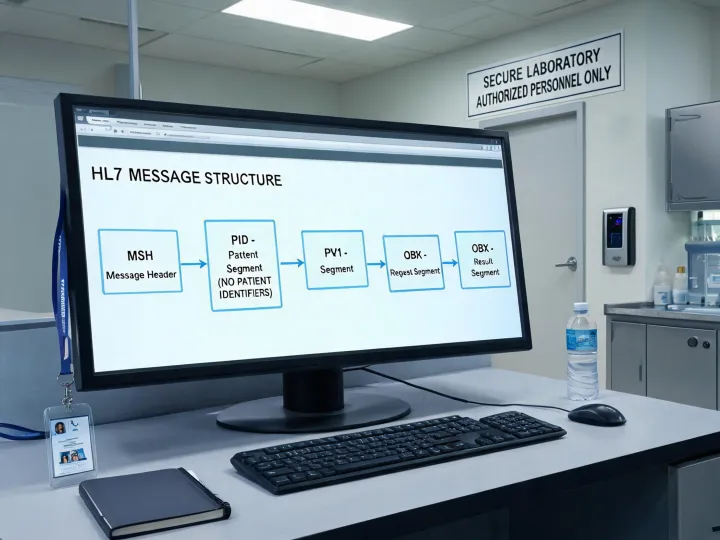
Process: The team defines specimens and concentrations, assigns operators, records reagent and calibrator lots, runs within-run and between-day precision, compares results with a current method using Deming regression and Bland–Altman review, and tests bidirectional HL7 v2.5.1 ORM/ORU messaging in a non-production environment. Coefficient of variation, bias, 95% limits of agreement, exception handling, and manual touches are retained with the raw data.
Result: The output is a signed acceptance matrix showing which intended uses passed, which require mitigation, and which remain outside the verified scope. It does not assume that an industry example or another site's result transfers unchanged.
“Capability is the range we can document under stated conditions, not the widest number printed on a comparison sheet.”Procurement principle used for this capability workflow
Method and workflow verification questions
How should precision be checked?
Predefine concentration levels, replicate count, operators, days, reagent lots, and acceptance limits. Report mean, standard deviation, and coefficient of variation. The instrument state and maintenance events remain part of the record.
What belongs in a method-comparison file?
Document the comparator, specimen selection, measurement interval, exclusion rules, regression method, bias across the range, 95% limits of agreement, and adjudication of discordant results. A correlation coefficient alone is insufficient.
How do centralized core labs and distributed testing differ?
Centralization supports automation, consolidated QC, and scale; distributed testing can shorten the care path. The trade-off involves transport time, operator competency, governance, connectivity, and the clinical cost of delay—not only reagent price.
What limits should remain visible?
Specimen interference, assay-specific intended use, lot variation, maintenance downtime, environmental range, sample integrity, operator competency, and interface fallback can all bound performance. Confirm exact limitations in the current IFU and local risk assessment.
Four evidence stations in a capability review


Share the assay menu and acceptance criteria
We will route the request by workflow, intended use, geography, interface, throughput profile, and service requirement.